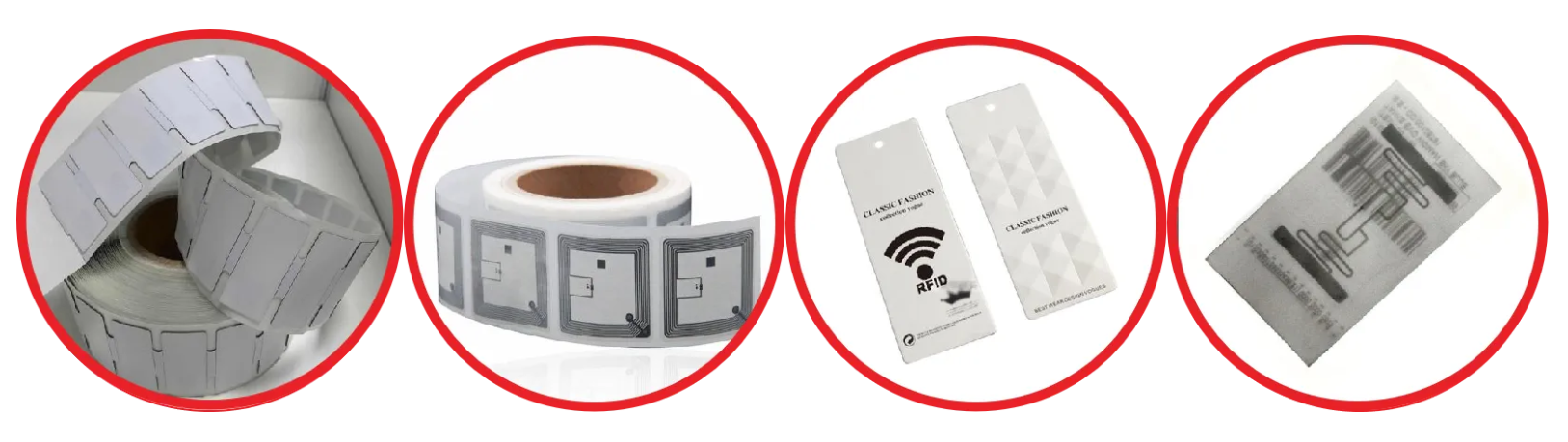
Above: Flexible anti-metal RFID tags; Self-adhesive RFID labels; RFID hangtags; RFID woven tags.
Determine Packaging Resource, RFID Encoder/Service Bureau
− Vendors can utilize their own RFID packaging resources to develop and print their RFID inlays but must adhere to the GS1 standards and ARC standards and obtain approvals from the Auburn University RFID Lab.
− A list of RFID packaging resources is available at https://rfidpackagingresources.org/. These are packaging providers that have supplied packaging for at least five RFID Retail Programs. This is NOT an endorsement or list of nominated suppliers.
− Vendors can also utilize other RFID packaging providers that are not listed. All label providers or packaging resources will need to source an Auburn University ARC-approved RFID inlay.
− A typical turnaround time for sourcing of encoded tags can take up to 3-4 weeks.
Identify Inlay Size
− Use the largest RFID inlay size available that fits your packaging.
− If your packaging does not fit the smallest inlay size available within the approved spec, add a generic embedded inlay hangtag or a separate paper-based sticker to your item.
Determine Placement of RFID Tags
− If your item is not represented in the Placement Guideline, please contact at
Tagging Requirements
− Make sure that that there is only ONE RFID tag per product.
− RFID tags must be removable by the customer. If sewn in, they must be removable.
− RFID tags can be placed inside the packaging if the EPC symbol is placed outside.
− RFID tags cannot be integrated into product.
− RFID tags or inlays cannot cover any text or images.
− If an item is being stickered, the domicile with the country of origin should not be covered up - it needs to be visible to the customer. The supplier can print the country of origin on the RFID sticker if needed.
− The RFID tag should not fall off the product easily.
− No staples, perforations, Swiftachs, folding or die cuts through the inlay as it will make the inlay unreadable.
− When choosing the tagging location, RFID readability should be considered while product is in salesfloor, backroom, and case pack. For example, the RFID tag cannot be placed on bottom of product since the tag will most likely be in direct contact with metal.
− When implementing RFID tags, you may discontinue source tagging with EAS tags. Should you choose to continue EAS tagging, RFID tags can be used in parallel with EAS tags but CANNOT be used/placed on top of each other.
− If the product could be merchandised without the packaging, the RFID tag should be attached to the product. For example: Grills, Patio Furniture etc.
− If the product comes in multiple cases (example, patio furniture set where the items are boxed separately from one another), ensure that there is only one tag on one of the cases. Please contact Auburn RFID Lab to determine the case to be tagged.
− No metal foils, holograms or metallic inks should be used on any packaging containing the RFID inlay. If so, you MUST receive the RFID Lab approval prior to bulk production of the printed packaging.
− No RFID inlay placement on bottom of polybags, bottom of boxed items, on glass, on liquids, on Silvadur, or near metal/foil.
− The performance of the RFID inlays could be affected by metals, foils, liquids, and glass. Special consideration must be taken when choosing tagging format and location for such products. Please contact the RFID lab at https://rfidlab.org/aleccontactform/.
EPC Symbol
− The EPC logo example represents the bare minimum of information that should be shown on your packaging to identify RFID tagging.
− Any packaging that has an RFID tag must have the Electronic Product Code (EPC) symbol displayed on the packaging for the customer and store associates to recognize.
− The EPC symbol should not be shown on any packaging that does not contain an RFID inlay. The EPC logo is an industry standard to inform the customer and store employee that the tag contains RFID. Having tags with an EPC logo and/or inlay but not properly encoded can cause major confusion within the process.
RFID Encoding & Serialization Requirements
− All tags are to be encoded appropriately per EPC Tag Data Standards (TDS), resulting in unique serialization for each item. The SGTIN-96 tag encoding standard maintained by GS1 is to be used.
− Please keep in mind that each serial number must be unique to that item and can run a risk of having duplicate numbers if not managed properly throughout the development process.
− Tags must be permalocked to prevent tampering.
− All tags must undergo quality and data integrity checks prior to entering the supply chain.
ALEC - Approval of Production RFID Packaging Samples
Auburn University RFID Lab’s ALEC program is to help vendors ensure that their RFID tagged items meet all Lowe’s and other major retailer requirements.
− Before any shipment of goods can begin, you must receive RFID lab Approval.
− If you have an item that has already received approval from ALEC, you can add Lowe’s as a retailer to the existing approval using the following form: https://rfidlab.org/submissionupdate/
− When creating a new submission, send five (5) EPC tag samples only (no product or packaging) to the RFID Lab for performance testing prior to bulk production. These may be branded hangtags, generic hangtags, or stickers.
− Submit one UPC per Submission Form.
− Not all UPCs supplied by a vendor requires a validation. Select one representative UPC (SKU) per product supplier per brand per packaging type per packaging agency per RFID Inlay model per tagging location. Send 5 inlay samples of the one representative UPC.
− RFID Tags MUST be production quality.
− The RFID Lab’s shipping information will be provided in the confirmation that you will receive after submitting the online submission form.
− Testing will not begin until the printed confirmation form has arrived at the lab.
− Actual product or packaging will only need to be sent when specifically requested by the RFID Lab.
Note: Any product sent to the RFID Lab will NOT be returned to the product vendor.
− Product Vendors are responsible for submitting their own samples to the RFID Lab. Packaging/tagging providers CANNOT submit samples on behalf the Product Vendors to the RFID Lab.
− Product Vendors who decide to switch inlay models and/or inlay providers and/or Service Bureau AFTER receiving validation from the RFID Lab, will need to re-submit tag samples again for validation.
− Product Vendors who decide to change/add new packaging with materials that may interfere with readability, will need to re-submit tag samples again for validation.
− The typical turn-around time of this process can take up to 10-14 days once the lab receives the tag samples.
Note: The online submission must be completed AND samples mailed into the lab before the ALEC team can start the review process.
− Once you receive an email approval from the RFID Lab, no further action is needed, and you are approved to move into bulk ordering and production.
Supplier Accountability
− Product vendors are required to have a process in place to ensure all tags leaving your facility are completely unique.
− Quality checking includes ensuring there are no duplicate serial numbers and that each tag is properly encoded for the item it is on.
− Any errors arriving at the stores will be the responsibility of product vendors.
RFID Shipper Case Markings
− For the stores to easily identify on cases which items have packaging with RFID labels. The Shipper Case Markings must include the word RFID.
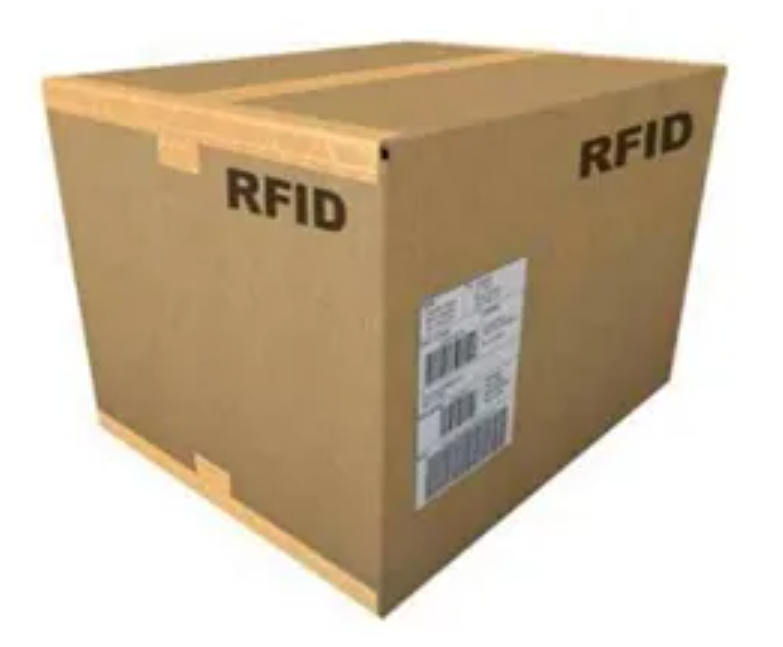
− Carton or carton labels do not carry any RFID inlays. Only the selling unit packaging carries the RFID inlay.
− The RFID marking is in addition to all other case markings and should not interfere with any other printed case markings, case labels, federal and state laws, or any other compliance related markings.
− If the product inside the case is not RFID labeled, do NOT use the updated RFID marking.
Overall:
For RFID industry application case studies, please contact us:
Hotline: +86 400-090-2003
Ningbo Juccce Intelligent Technology Co., Ltd. has been focusing on the barcode and RFID fields, collaborating closely with leading enterprises across various industries worldwide. We operate three label and RFID production facilities, providing sufficient capacity, high shipment volumes, and excellent product quality. Our successful application cases cover diverse sectors. Combining software and hardware development, optimization, and after-sales maintenance capabilities, we provide comprehensive end-to-end solutions for numerous enterprises. These solutions help corporate clients significantly reduce labor and material costs in warehouse management, logistics optimization, anti-counterfeiting, and traceability, while also delivering substantial economic benefits. The specifications of the composite chip inlays developed by Juccce fully meet the RFID chip model and performance requirements of major brands, including numerous global retailers and supermarket chains.
Juccce's RFID tag products can be applied across major industries currently utilizing RFID, including home goods, electronics, toys, apparel and footwear, jewelry, and sports and outdoor equipment. We have rich experience with successful case studies in all these sectors. In the RFID tag sector, Juccce offers the following advantages:
1. Excellent Production Capabilities: With over 20 years of industry expertise, Juccce can provide multiple solutions for diverse client requirements regarding chip materials and performance in RFID applications. We produce samples for client testing and adjustments, striving to meet or exceed customer expectations. Our RFID tag portfolio includes, but is not limited to: retail tags, hangtags, woven tags, anti-metal tags, liquid-resistant tags, and tamper-evident tags.
2. Comprehensive Solution Capability: Many enterprise clients require a complete, highly compatible, and user-friendly RFID system encompassing both hardware and software. Juccce delivers precisely such an integrated solution. Our dedicated teams handle software development, hardware debugging, and after-sales service, ensuring seamless application and optimization across the entire ecosystem to provide genuine one-stop service.
3. Efficient Production and Delivery: Juccce's factory operates with unwavering dedication, enabling on-demand production at any time. Regarding customer delivery requirements, our slogan is: “Always early, never late.”
Juccce China Headquarters Address: No. 26, Liando U Valley, Lane 777, Qingfeng Road, Jiangbei District, Ningbo City, Zhejiang Province, China
Hotline: +86 400-090-2003, Mrs Amin
Or +86 18069637217, Orion Chen


 Hot News
 EN
EN