
 EN
EN
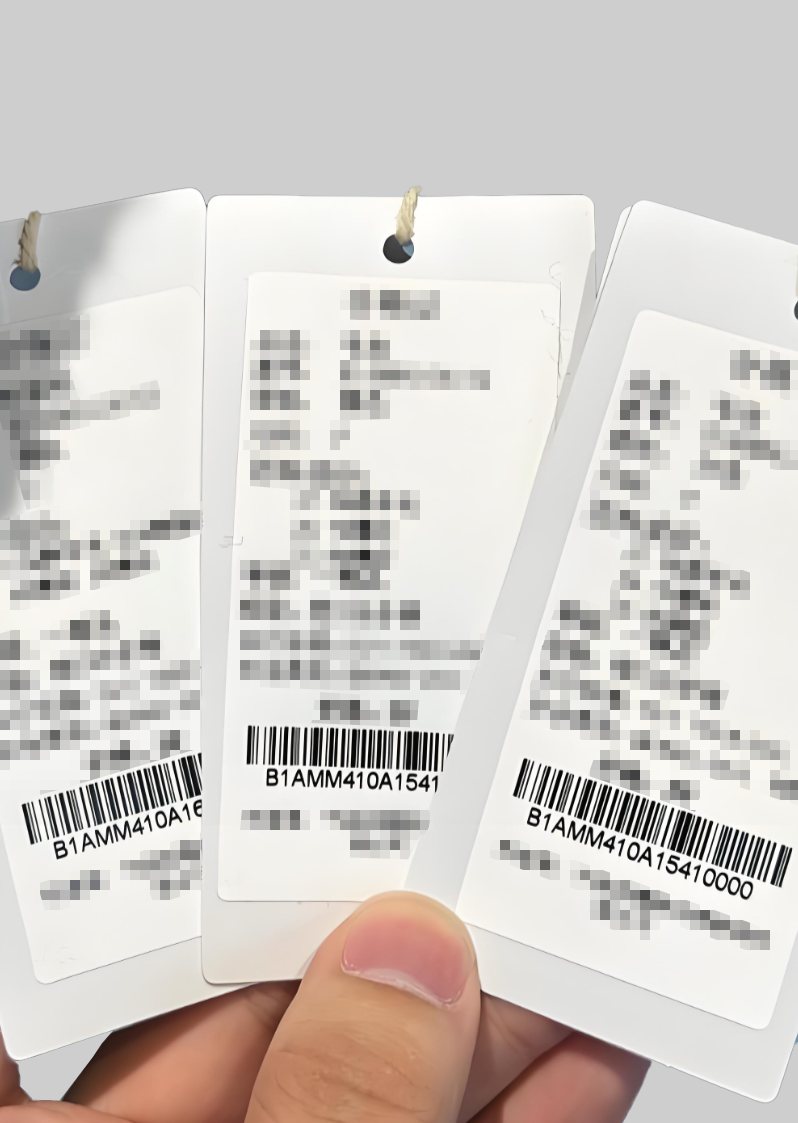
Barcode Quality and Symbology: The Foundation of Reliable Scanning
Print contrast, quiet zone integrity, and common degradation causes (smudging, fading, creasing)
High print contrast between bars and spaces is essential for accurate decoding—scanners rely on sharp optical differentiation to distinguish encoded data. Equally critical is quiet zone integrity: the unmarked margin surrounding the barcode must remain free of text, graphics, or smudges to prevent misreads. Physical degradation remains a leading cause of scan failure:
- Smudging from moisture, oils, or abrasion blurs bar edges and collapses contrast
- Fading, often triggered by UV exposure or chemical contact, erodes the reflectance differential scanners require
- Creasing, especially in 2D symbologies like Data Matrix, distorts geometric alignment and disrupts pattern recognition
Warehouse environments experience a 40% increase in scanning failures from label damage compared to climate-controlled settings (Logistics Tech Review 2023). For demanding industrial use, thermal-transfer printing on polyester labels delivers superior resistance to abrasion, heat, and solvents—making it the benchmark for long-term readability.
Symbology selection guide: When to use Code 128, QR Code, or Data Matrix for optimal barcode accuracy
Symbology choice directly determines decoding reliability, data capacity, and operational fit:
- Code 128 delivers 98% first-pass read rates in high-speed conveyor logistics due to its compact, alphanumeric efficiency and strong error correction
- QR Codes support omnidirectional scanning, large data payloads (up to 4,296 alphanumeric characters), and native kanji/Chinese character encoding—ideal for global retail packaging
- Data Matrix encodes up to 2,335 ASCII characters in as little as 2.5 mm², making it the standard for micro-labeling on electronics, medical devices, and surgical instruments
Healthcare facilities adopting Data Matrix for specimen vials reduced misidentification errors by 67% (Journal of Clinical Informatics 2024). Selection should prioritize three practical criteria: required data capacity, available label real estate, and the scanner hardware deployed across your workflow.
Scanner Hardware Capabilities and Their Impact on Barcode Decoding
Imaging sensor resolution, low-light performance, and motion tolerance in barcode scanners
Modern imaging sensors are foundational to reliable decoding—not just for resolution, but for intelligent capture under variable conditions. Sensors with ≥2MP resolution provide sufficient pixel density to resolve narrow elements (e.g., 5-mil bars), while advanced low-light performance enables 20% higher first-read rates in sub-50 lux warehouse lighting (2024 Material Handling Studies). Motion tolerance—measured in inches per second (IPS)—is equally decisive: industrial-grade imagers now sustain >2 m/s conveyor speeds using multi-frame capture and motion-compensated decoding algorithms. Together, these capabilities mitigate environmental and operational variability that otherwise triggers no-reads.
Illumination design—LED vs laser—and how uniform lighting prevents barcode misreads
Illumination isn’t auxiliary—it’s an active decoding enabler. LED-based systems deliver diffuse, wide-angle lighting ideal for curved, glossy, or textured surfaces, eliminating hotspots and specular glare that confuse traditional scanners. Laser illumination offers longer working distances (up to 15 ft) but struggles with reflective substrates and narrow depth-of-field constraints. Crucially, uniform coverage prevents two dominant failure modes: shadowing (incomplete symbol capture) and contrast washout (specular reflection). Retail POS studies confirm optimized LED illumination reduces misreads by 30% versus single-point sources—by ensuring consistent reflectance across the entire symbol.
Environmental and Operational Conditions That Challenge Barcode Accuracy
Environmental stressors degrade both label integrity and optical signal quality—often silently, until a critical failure halts a production line or delays patient care. Ambient light, surface reflectivity, temperature swings, humidity, and substrate curvature each introduce distinct decoding challenges. Addressing them requires coordinated attention to label material, symbology choice, scanner configuration, and facility-level lighting design.
Ambient light interference, reflective surfaces, and lighting best practices by setting (warehouse, retail, healthcare)
Uncontrolled ambient light—especially direct sunlight or high-intensity fluorescent fixtures—reduces effective contrast, mimicking a faded barcode. Glossy packaging, plastic overwraps, and metallic surfaces generate specular reflections that saturate scanner sensors. Mitigation is setting-specific:
- Warehouses: Use diffused, high-CRI LED ceiling lighting to eliminate harsh shadows and minimize glare on palletized goods
- Retail: Install anti-glare shelving and position scanners at 30–45° angles to reduce reflection off product packaging
- Healthcare: Maintain cool-white, consistent illumination (4000–5000K) to preserve contrast on sensitive patient wristbands and specimen labels without disrupting clinical workflows
Always place barcodes on flat, matte-finish surfaces when possible—and train staff to dynamically adjust scanner distance and angle, which alone can improve first-read rates by up to 15%.
Temperature, humidity, and substrate curvature effects on label readability and optical distortion
Thermal and moisture extremes compromise label adhesion and ink stability: heat accelerates adhesive creep and label curl; cold embrittles paper and synthetic films; high humidity promotes ink bleeding and condensation-induced fogging. Curved substrates—including bottles, syringes, and cylindrical electronics housings—distort barcode geometry, collapsing quiet zones and compressing bar widths beyond scanner tolerance. To maintain focus and fidelity:
- Apply labels to the flattest practical surface area
- Specify flexible, conformable materials (e.g., polypropylene or specialty vinyl) for curved applications
- Choose industrial-grade synthetic labels (polyester, polyimide) over paper for sustained performance across –40°C to +150°C and 10–95% RH ranges
These material and application decisions are as consequential to scan reliability as scanner optics or symbology selection—yet are frequently overlooked in system design.
FAQ Section
What is the quiet zone in a barcode?
The quiet zone is the unmarked margin surrounding a barcode. It must remain free of text, graphics, or smudges to ensure accurate scanning and decoding.
Which symbology is ideal for small labels?
Data Matrix is ideal for micro-labeling due to its ability to encode up to 2,335 ASCII characters in a minimal space, as small as 2.5 mm².
How do different environmental conditions affect barcode readability?
Temperature swings, humidity, substrate curvature, and ambient light can degrade label adhesion, ink stability, and barcode geometry, impacting readability.
What are the advantages of LED-based barcode scanners compared to laser scanners?
LED-based scanners provide diffuse lighting, making them better suited for curved, glossy, or textured surfaces compared to laser scanners, which excel at long distances but may struggle with reflective substrates.
How can warehouses optimize barcode scanning environments?
Warehouses should employ high-CRI LED lighting to reduce shadows and glare while training staff to adjust scanner angles dynamically for improved readability.