
 EN
Core Technical Differences: Optical Scanning vs Radio-Frequency Identification
How barcode labels rely on line-of-sight, sequential optical scanning and static data
Barcode labels encode data in a pattern of parallel bars and spaces read by an optical scanner. The scanner must have a clear, direct line-of-sight to the label, and reading is limited to close range—typically 3–10 cm. Each label must be scanned individually and sequentially, making high-speed operations dependent on operator precision. The encoded data is static: once printed, it cannot be altered without replacing the label. A standard 1D barcode holds 20–100 bytes—sufficient only for a product ID or serial number. Because barcodes are printed with ink on paper or film, they’re vulnerable to abrasion, smudging, and tearing in industrial settings, directly contributing to read failures. These constraints make barcodes ideal for simple, low-cost tracking in controlled environments.
How RFID labels enable non-line-of-sight, bulk reads and dynamic data updates via UHF/NFC radio waves
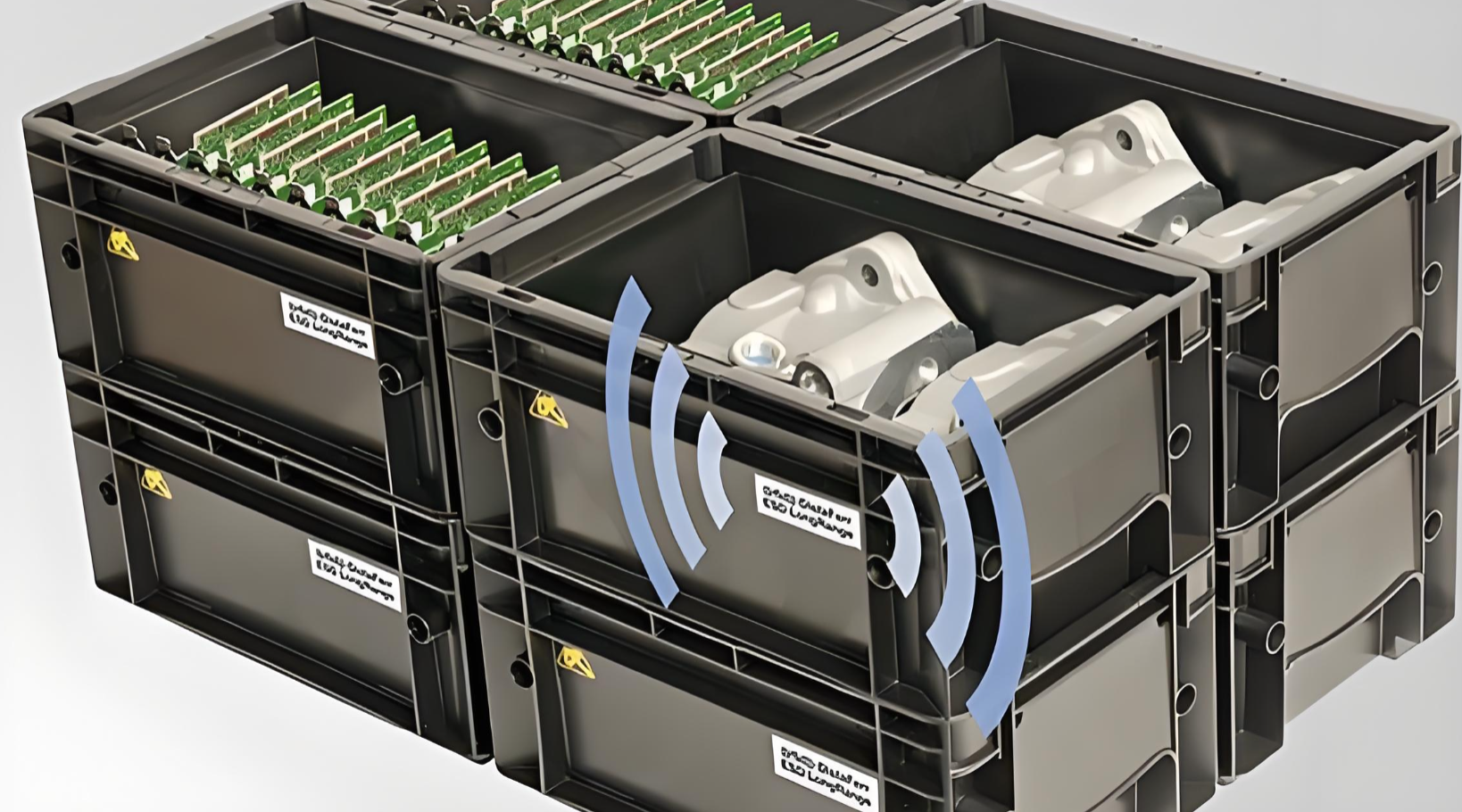
RFID labels integrate a microchip and antenna that communicate via radio waves—eliminating the need for line-of-sight. Readers can interrogate tags through packaging, cardboard, or non-metallic containers. Ultra-high frequency (UHF) RFID supports read ranges up to 12 m; Near-Field Communication (NFC) variants operate at a few centimeters for secure, one-to-one exchanges. Crucially, UHF readers capture hundreds of tags per second simultaneously—enabling true bulk reads that slash inventory cycle times. RFID memory is rewritable, with typical capacities of 1–8 KB, supporting dynamic updates throughout an item’s lifecycle. Data can be encrypted, and read/write operations complete in milliseconds. This combination of non-line-of-sight operation, speed, and reprogrammability enables real-time visibility and automation across complex, demanding supply chains.
Operational Performance: Read Range, Speed, Accuracy, and Data Flexibility
Comparing real-world read performance: 3–10 cm (barcode) vs. up to 12 m (UHF RFID) and first-pass accuracy in challenging environments
The core operational divide stems from physics: barcodes rely on optical reflection, while RFID uses radio-frequency transmission. Barcodes require unobstructed line-of-sight and are restricted to 3–10 cm for standard imagers. Scanning is inherently sequential—each item must be oriented and triggered individually. In contrast, UHF RFID operates without visual alignment and achieves up to 12 m of reliable read distance. This unlocks bulk reading: hundreds of tags pass through a portal and are captured in one go. In practice, this translates to superior first-pass accuracy under stress. A dusty, crumpled, or poorly lit barcode on a fast-moving conveyor often fails—triggering manual re-scans and exception handling. UHF RFID maintains near 100% first-pass success through grime and non-metallic packaging, eliminating labor-intensive recovery workflows and their associated cost drag (AIM Industry Group, 2023).
Static capacity vs. rewritable memory: 20–100 bytes (barcode) vs. 1–8 KB (RFID labels)
Barcodes function as immutable reference keys—encoding only 20–100 bytes of static data, usually a database lookup identifier. Once printed, that data remains fixed for the label’s lifetime. RFID labels, by contrast, serve as portable, rewritable databases. Their integrated chips offer 1–8 KB of user memory, enabling dynamic updates at every touchpoint: timestamps, temperature logs, quality status, or maintenance records can be written directly onto the tag. This eliminates dependency on real-time network connectivity and central database queries, allowing decentralized, offline decision-making at the point of use—critical for edge-based automation and resilience in distributed operations.
Durability, Environmental Resilience, and Total Cost of Ownership
Barcode vulnerability to abrasion, smudging, and lighting vs. RFID labels’ epoxy-encapsulated chip durability in washdown, extreme temperatures, and EMI-heavy facilities
Barcodes are physically fragile. A scratch, smudge, glare, or moisture spot can obscure the pattern and block scanning—forcing manual entry or label reprinting. In wet, dusty, or high-contrast lighting conditions, misreads multiply, slowing throughput and increasing error-handling overhead. RFID labels embed the chip and antenna in ruggedized resin or epoxy encapsulation, shielding electronics from impact, moisture, abrasives, and condensation. Hardened variants withstand repeated industrial washdowns, operate continuously at –40 °C or above 80 °C, and maintain reliability on metal surfaces where electromagnetic interference would disrupt optical systems. Modern UHF RFID also employs frequency-hopping spread spectrum and adaptive filtering to sustain performance in electrically noisy environments—ensuring uninterrupted visibility of mission-critical assets.
Upfront cost vs. lifecycle value: $0.03–$0.15/barcode vs. $0.25–$3.50/RFID label — and when ROI justifies the premium
Unit cost disparity is real: barcodes cost $0.03–$0.15 each; RFID labels range from $0.25 to $3.50, depending on ruggedness and form factor. But total cost of ownership includes recurring labor, errors, and downtime—not just sticker price. Scanning 200 items manually may take two minutes per box; an RFID portal captures all 200 in one pass, rapidly amortizing the per-tag premium. ROI crystallizes around asset value and process velocity. For disposable packaging or short-cycle retail, barcodes remain optimal. But for reusable containers, high-value spare parts, or surgical instruments, RFID’s benefits compound: near-elimination of manual counts, 70–90% reduction in stock-outs, and real-time rerouting capability. Lifecycle analysis shows breakeven in 12–18 months with just a 2% reduction in asset loss or 15 minutes of daily labor saved—making the initial investment a strategic enabler, not an expense.
Strategic Application Mapping: When to Choose Barcode Labels vs RFID Labels
Barcode labels excel in high-volume, low-value, short-cycle operations — retail POS, pharmaceutical unit-dose packaging, and small-batch inventory
Barcodes thrive where simplicity, speed, and low unit cost align with predictable, manual workflows. At retail point-of-sale, cashiers scan $0.03 labels on fast-moving goods—item lifecycles end within minutes. In pharmaceutical unit-dose packaging, barcodes provide precise, item-level verification for low-cost consumables in controlled, one-at-a-time nurse-station workflows. Small-batch inventory also favors barcodes: manually scanning 50 items often costs less than deploying RFID infrastructure. Their value lies in being disposable, on-demand identifiers—printed nearly free, read by commodity scanners, and discarded with the package. When assets are low-value and cycles are measured in hours, the marginal gain of RFID rarely justifies its cost.
RFID labels deliver transformative ROI in high-value, automation-dependent, real-time visibility use cases — automotive Tier-1 logistics, hospital asset tracking, and returnable container systems
RFID delivers disproportionate value when failure cost or manual labor exceeds tag expense. In automotive Tier-1 logistics, missing a single $50 seat module shipment can idle a production line at $15,000/minute; bulk-scanning RFID at gateways ensures 99.9% shipping accuracy without slowing truck throughput. Hospitals offset a $1.50 RFID label on an infusion pump against hours of nursing time previously spent searching—directly expanding care capacity. The strongest ROI emerges in returnable container systems: a durable RFID label on a reusable tote, rewritten thousands of times across manufacturer–retailer loops, provides automated chain-of-custody proof, eliminates manual cycle counting, and prevents the 15–20% annual attrition common in unmonitored pools. Here, the label functions not as a consumable—but as closed-loop infrastructure, paying for itself in three to five cycles through labor avoidance and loss prevention alone.
FAQ
What are the key differences between barcode labels and RFID labels?
Barcodes require line-of-sight scanning and encode static data, while RFID labels operate without line-of-sight, support dynamic data updates, and enable bulk reading.
How much data can barcode and RFID labels store?
Barcode labels hold 20–100 bytes of static data, while RFID labels provide 1–8 KB of rewritable memory for additional information.
Which is more durable: barcodes or RFID labels?
RFID labels are more durable, as they are encapsulated in rugged materials that protect them from environmental factors like abrasion, moisture, and extreme temperatures.
Are RFID labels more expensive than barcodes?
Yes, RFID labels cost between $0.25 and $3.50, while barcodes typically cost $0.03–$0.15. However, RFID offers significant ROI in automation and asset tracking scenarios.
When should I choose barcodes over RFID labels?
Barcodes are suitable for low-value, high-volume operations where cost efficiency and simplicity are prioritized, such as retail POS or pharmaceutical packaging.
What are the best use cases for RFID labels?
RFID is ideal for high-value, automation-heavy scenarios requiring real-time visibility, such as automotive logistics, hospital asset tracking, and reusable container systems.
Table of Contents
- Core Technical Differences: Optical Scanning vs Radio-Frequency Identification
- Operational Performance: Read Range, Speed, Accuracy, and Data Flexibility
- Durability, Environmental Resilience, and Total Cost of Ownership
-
Strategic Application Mapping: When to Choose Barcode Labels vs RFID Labels
- Barcode labels excel in high-volume, low-value, short-cycle operations — retail POS, pharmaceutical unit-dose packaging, and small-batch inventory
- RFID labels deliver transformative ROI in high-value, automation-dependent, real-time visibility use cases — automotive Tier-1 logistics, hospital asset tracking, and returnable container systems
- FAQ